
Real Estate Investment Renovation & Project Management in Laguna Beach: Manage the Decisions Before They Become Construction
The most expensive renovation decisions do not always look expensive when they are made.
- CSLB licensedLicense No. 1146843
- Design + buildOne in-house team
- Permits handledPlans, submittals, inspections
- Laguna BeachReply within one business day
The most expensive renovation decisions do not always look expensive when they are made.
Moving a wall on a drawing may seem minor until it changes structure, lighting, flooring, cabinetry and mechanical work.
Choosing a different window system can affect framing, waterproofing, exterior elevations, lead times and installation details.
Changing the kitchen after cabinetry is released can touch appliances, stone, plumbing, electrical work and schedule at the same time.
A project rarely loses control because of one dramatic mistake.
More often, it happens through a sequence of individually reasonable decisions that were never evaluated together.
That is the core challenge behind Real Estate Investment Renovation & Project Management in Laguna Beach.
For an owner, investor or developer, the project is not simply a renovation. It is a series of commitments of capital, design, time and construction risk. The purpose of project management is to make those commitments in the right order, with enough information to understand their consequences.
RODEWE approaches that work from both design and construction perspectives. The objective is not simply to produce an attractive finished house. It is to help the owner make better decisions about what should change, where investment matters, what can remain restrained, and how those decisions are carried into construction.
An Investment Renovation Needs a Point of View Before It Needs a Finish Schedule
Every meaningful renovation should answer one question before material selection becomes serious:
What is this project trying to accomplish?
That answer changes the design.
A long term personal residence can justify decisions based on daily enjoyment, durability and highly specific preferences.
A property intended for resale may benefit from a different degree of personalization.
A long term investment may place additional emphasis on maintenance, adaptability and material longevity.
A newly acquired property may need strategic work in only a few places rather than an indiscriminate whole house upgrade.
Without that distinction, renovation budgets can drift.
A project begins with one objective, then individual upgrades gradually change its character. A bathroom specification moves higher. The cabinetry becomes more complex. Several architectural modifications are added. Specialty materials enter the project one room at a time.
No individual decision seems unreasonable.
The cumulative project may be completely different from the original plan.
RODEWE therefore treats the initial renovation brief as more than a design mood.
It should define priorities, intended use, approximate capital allocation, desired design level, important deficiencies in the existing property, schedule considerations, and the areas where restraint is intentional.
That document provides something valuable later:
a reason to say yes, no, or not yet.
In Laguna Beach, the Property Should Be Investigated Before the Renovation Is Fully Imagined
Some homes invite an immediate design reaction.
The better first move is often investigation.
Laguna Beach's planning process makes this especially relevant. The City advises property owners to investigate applicable ordinances, zoning regulations, Specific Plans, General Plan policies and the Local Coastal Program before preparing construction plans. Depending on the property and scope, discretionary approvals may be required before structural plans proceed to building permitting.
The City's permit process can also involve zoning review, setbacks, height, parking, open space, lot coverage, environmental review and, where applicable, additional technical studies such as geotechnical, hydrology or grading information.
That does not mean every Laguna Beach renovation is unusually complicated.
It means assumptions should be property specific.
Before a major investment renovation is priced too confidently, it may be appropriate to understand:
the existing building and permit history,
the intended scope,
which exterior changes are being proposed,
whether the project changes floor area or massing,
site access,
structural conditions,
existing building systems,
possible planning approvals,
and which design ideas may trigger more extensive review.
A beautiful concept that ignores the approval path is not yet a complete project strategy.
Think in Terms of Irreversible and Reversible Decisions
Not all renovation decisions deserve the same amount of time.
Some are relatively easy to change.
Paint.
Loose furniture.
Artwork.
Decorative accessories.
Other decisions become embedded in the building.
Room geometry.
Structural openings.
Window placement.
Plumbing locations.
Waterproofing.
Electrical infrastructure.
HVAC.
Cabinet dimensions.
Stone fabrication.
Floor elevations.
Those decisions become progressively more expensive to reverse.
That creates a useful management principle:
resolve irreversible decisions before spending too much energy on reversible ones.
It sounds obvious.
In practice, renovation projects frequently do the opposite because finish selections are easier and more enjoyable to discuss than technical coordination.
A homeowner may spend hours comparing faucets while a cabinet elevation remains unresolved.
A decorative pendant may be selected before the dining table location is confirmed.
A stone slab may be reserved before the final cabinet dimensions establish how much material is actually required.
Investment renovation benefits from putting decisions in the correct hierarchy.
The Best Value Engineering Happens Before Something Has to Be Removed
“Value engineering” is often introduced when a budget is already too high.
At that point it can feel like subtraction.
Remove the custom detail.
Choose the cheaper tile.
Reduce the lighting package.
Simplify the cabinetry.
That is late value engineering.
Earlier value engineering is more strategic.
Could the floor plan solve the same problem without moving a major structural wall?
Could plumbing locations remain reasonably consolidated without compromising the bathroom?
Could cabinetry absorb storage that would otherwise require expanding the room?
Could one exceptional natural stone be used selectively instead of applying premium stone everywhere?
Could an existing architectural feature be retained and incorporated rather than demolished and recreated?
The objective is not to make a high end project cheap.
It is to avoid paying for complexity that produces little improvement.
That distinction is especially important for real estate investment renovation, where an expensive solution is only useful when it materially improves the property, the user experience or the intended positioning of the finished residence.
Follow the Ripple Effect Before Approving a Change
One of the most useful project management habits is refusing to evaluate a change in isolation.
Suppose the owner wants to move a kitchen island six inches.
That may sound minor.
Does the pendant lighting move?
Does the floor outlet move?
Does the plumbing move?
Do clearances around the island still work?
Does the stone slab layout change?
Does the dining relationship improve or get worse?
Is cabinetry already in production?
A small request can become a multi trade event.
The same applies to windows, bathroom fixtures, door openings, lighting and finish changes.
A useful change review therefore asks four questions:
What is changing?
What else does it affect?
What is the total cost consequence?
What is the schedule consequence?
The first question is usually easy.
The other three protect the project.
A Construction Budget Is a Forecast, Not a Historical Record
Knowing how much money has already been spent is useful.
Knowing what the project is currently expected to cost when finished is more useful.
That is the difference between cost to date and cost to complete.
A project can appear comfortably within budget while significant commitments remain unresolved.
Cabinet fabrication.
Stone.
Windows.
Lighting.
Plumbing fixtures.
Appliances.
Custom glass.
Furniture.
Exterior work.
Owner selections.
Potential changes.
Those costs may not yet appear in paid invoices.
For investment renovation and project management, financial reporting should therefore keep sight of the future.
The working budget can distinguish between contracted cost, amounts already paid, approved changes, pending changes, allowances, owner supplied items, unresolved scope and projected cost to complete.
This creates a more honest picture of where the project stands.
Allowances Should Become Decisions as Early as Practical
Allowances are useful when every product cannot be selected before pricing.
They become dangerous when they remain vague for too long.
A plumbing allowance tells the project very little if the owner eventually chooses fixtures requiring different rough locations, valves or installation details.
A lighting allowance does not resolve fixture lead times or ceiling conditions.
A cabinet allowance does not establish construction type, hardware, interior accessories or finish quality.
Allowances should therefore have an expiration date in the project decision process.
At some point, placeholders need to become actual specifications.
The earlier that transition happens, the more accurately the team can understand both cost and coordination.
The Decision Schedule Can Be as Important as the Construction Schedule
A project schedule might show framing, electrical rough work, drywall, flooring and cabinetry.
It should also anticipate when decisions need to happen.
Appliances may need to be finalized before cabinetry.
Cabinet drawings need approval before fabrication.
Some plumbing fixtures should be known before rough plumbing.
Lighting should be coordinated before ceilings are closed.
Stone cannot be fabricated until field dimensions and relevant fixtures are available.
Custom windows and doors can affect the schedule long before installation begins.
This creates a second timeline running alongside construction:
the decision schedule.
For each significant item, the useful questions are:
When is information needed?
Who needs to provide it?
Who approves it?
When must it be purchased?
What activity depends on it?
A late decision can delay a project just as effectively as a late subcontractor.
Procurement Is the Moment Design Becomes Financial
A specification is still relatively flexible while it exists on paper.
A purchase order changes that.
Once custom cabinetry enters production, windows are ordered, stone is purchased or specialty fixtures are released, design decisions become financial commitments.
Procurement therefore deserves more management attention than simply asking whether something has been ordered.
For significant products, the project should understand:
approved specification,
quantity,
price,
lead time,
required deposit,
expected delivery,
storage requirements,
installation prerequisites,
and responsibility for checking the product when it arrives.
A beautiful fixture arriving at the wrong time can still create a problem.
So can a product ordered early and damaged while stored on site.
Good procurement is not simply early procurement.
It is coordinated procurement.
A Kitchen Is a Good Example of Why Design and Construction Cannot Operate Separately
A high end kitchen contains an unusually dense collection of decisions.
Appliances determine cabinet dimensions.
Cabinetry influences outlets and lighting.
Plumbing affects sink and dishwasher locations.
Ventilation interacts with architecture.
Stone depends on final dimensions.
Flooring runs beneath or around different elements depending on the system.
Hardware influences both appearance and daily function.
Furniture affects clearances around the island.
That means the kitchen cannot be designed as a collection of independent selections.
Spend Where the Architecture Notices
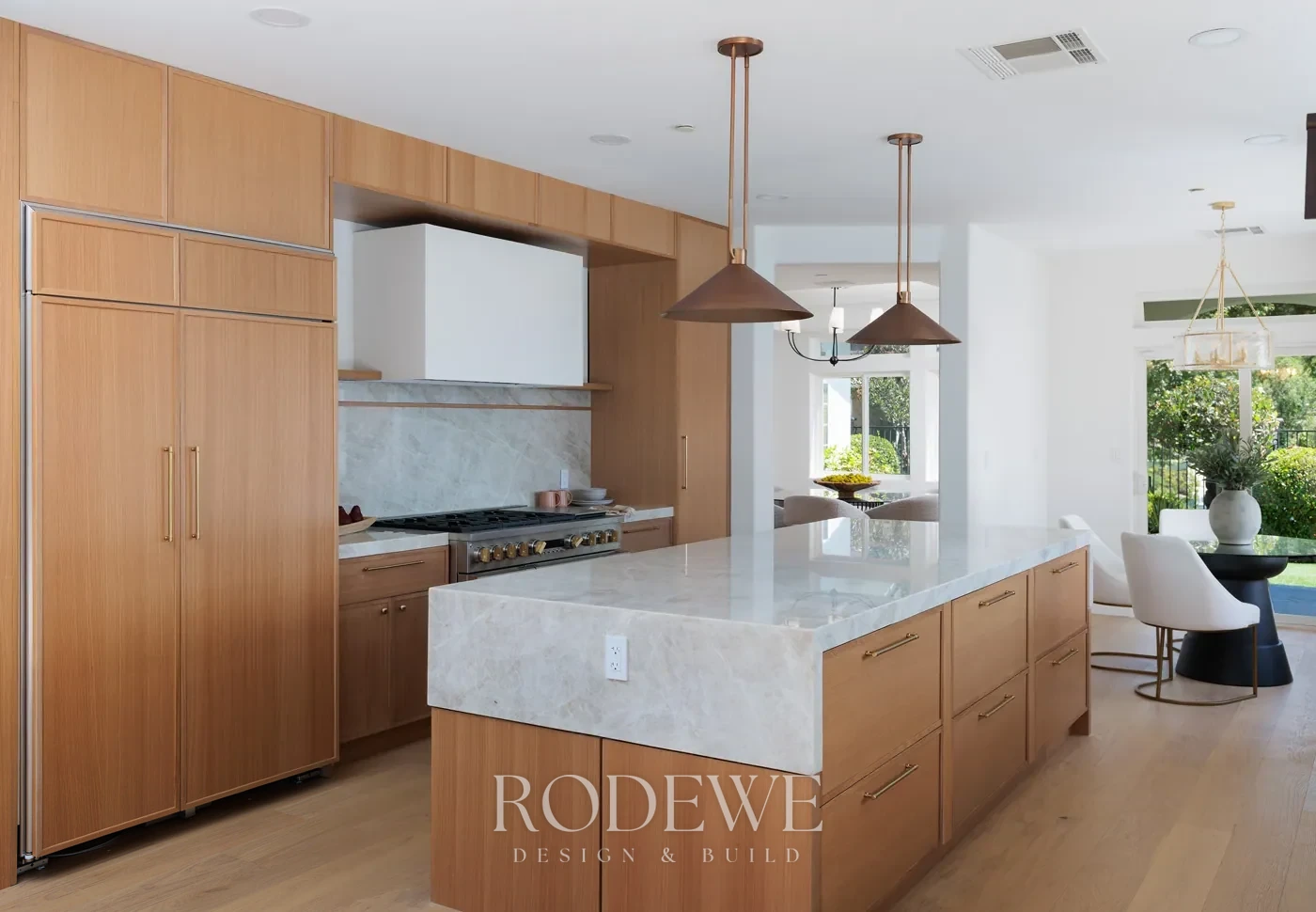
Custom cabinetry can justify substantial investment when it improves storage, proportions and architectural clarity.
Natural stone can be highly effective where its variation and scale become part of the room.
High quality doors and windows may influence the experience of light and outdoor connection every day.
Good lighting can change the atmosphere of the entire interior.
But more expensive is not automatically more resolved.
A premium material installed in the wrong proportion remains the wrong decision.
Investment should follow design impact.
Bathrooms Are Small Rooms With Large Coordination Requirements
Bathrooms can consume a disproportionate amount of renovation attention because so many trades occupy a relatively small area.
Framing.
Waterproofing.
Plumbing.
Electrical.
Lighting.
Stone or tile.
Cabinetry.
Glass.
Hardware.
Ventilation.
The layout should therefore be solved before the decorative layer becomes dominant.
Can drawers open?
Is there somewhere for towels?
Does the shower entry work comfortably?
Where are toiletries stored?
Does the mirror lighting illuminate the face effectively?
Is plumbing located where sound will become an issue in an adjacent bedroom?
Natural stone and custom finishes can elevate a bathroom considerably, but precision should come first.
Luxury is difficult to achieve when basic relationships are unresolved.
Furniture Planning Protects the Architecture From Looking Good Only on Drawings
One of the easiest ways to make a renovation plan look generous is to draw furniture too small.
Real furniture has consequences.
A deep sofa needs circulation behind it.
A dining chair needs space to pull away from the table.
A king bed requires room at both sides.
A media wall needs an uninterrupted surface.
A floor lamp needs an outlet.
A dining fixture needs a centerline.
This becomes particularly important when renovating homes with significant glazing or views.
Windows are valuable, but interiors still need walls.
Furniture coordination can reveal that a window should move slightly, an opening should become narrower, or a room should be proportioned differently.
Those adjustments are inexpensive during design.
They are not inexpensive after framing.
In Laguna Beach, Views Should Be Treated as an Asset Without Letting Them Design the Entire Interior
It is understandable for a renovation to prioritize an ocean, canyon or city view where one exists.
The mistake is assuming that every wall should disappear in response.
Glass influences furniture, privacy, solar exposure, lighting and storage.
At night, a highly glazed room behaves differently than it does during the day.
Large openings can also introduce structural, waterproofing and exterior detailing requirements.
The better design question is not:
“How much glass can we add?”
It is:
“Where does the view create the greatest value to the room?”
A carefully framed view can sometimes contribute more than indiscriminate glazing.
That also leaves architecture available for art, cabinetry, furniture and moments of enclosure.
Material Selection Should Consider the Next Repair, Not Just the Installation
Investment minded material selection asks a different set of questions from showroom selection.
How does this surface age?
What maintenance does it require?
How difficult is it to repair?
If part of it is damaged three years from now, can it be matched?
Does the finish depend on unusually specialized labor?
Will natural variation improve the appearance over time or make future patching obvious?
None of this argues against premium material.
Natural stone, wood, custom plaster, specialty metal and handcrafted finishes can give a project significant character.
The point is to select them knowingly.
A high end renovation should feel rich because materials are used deliberately, not because every available surface received the most expensive specification.
Some of the Most Important Project Management Happens Before Construction
Preconstruction is where the owner still has the greatest flexibility.
The drawings can change without demolition.
A contractor can be compared with another contractor.
A specification can be reconsidered before purchase.
A structural solution can be studied before labor is mobilized.
For a substantial Laguna Beach renovation, preconstruction management may include scope definition, consultant coordination, design review, preliminary budgeting, constructability discussion, bid analysis, schedule planning, procurement forecasting and identification of unresolved decisions.
The purpose is not to predict every construction condition perfectly.
That is impossible in an existing building.
The purpose is to enter construction knowing which uncertainties remain instead of discovering that fundamental questions were never asked.
Contractor Proposals Should Be Leveled Before They Are Ranked
A lower proposal is not necessarily a lower price for the same work.
It may simply describe less work.
One contractor may include temporary protection.
Another may exclude it.
One includes detailed site supervision.
Another prices it separately.
One carries realistic allowances.
Another uses numbers unlikely to support the intended finish level.
One includes painting throughout affected areas.
Another prices only new construction.
Comparing the totals without comparing the assumptions can produce a false conclusion.
A useful bid review creates a common basis.
Scope.
Exclusions.
Allowances.
Alternates.
Supervision.
Insurance.
Schedule assumptions.
Owner supplied items.
Potential gaps.
Then the owner can evaluate the price.
That is different from simply selecting the lowest number.
The Owner Needs One Place Where Decisions Are Recorded
Complex projects generate information everywhere.
Email.
Text messages.
Meeting notes.
Architectural drawings.
Shop drawings.
Vendor proposals.
Change orders.
Site conversations.
Invoices.
Selection schedules.
When important decisions are scattered among these channels, memory becomes part of the project management system.
That is risky.
A simple decision register can identify the issue, decision, responsible party, date required, date resolved and any cost or schedule consequence.
This is particularly useful when several professionals are involved.
It reduces arguments about who remembers what and creates a clearer project history when a decision needs to be revisited later.
Owner Representation Is Different From Simply Managing Construction
For some projects, the owner does not want to personally sit at the center of every meeting, proposal, selection and contractor question.
That creates a role for an owner's representative.
The representative participates from the owner's side of the table.
Depending on the engagement, that can include meeting participation, budget and schedule review, proposal analysis, coordination of owner decisions, change review, follow up on open issues, documentation, site observations and communication with the design and construction team.
The architect still owns architectural responsibilities.
Engineers remain responsible for their engineering.
The general contractor remains responsible for construction obligations under its agreement.
The owner's representative has a different question:
Is the owner getting the information needed to make an informed decision?
RODEWE Can Represent an Owner on New Construction
The same decision management becomes relevant in ground up residential construction.
New construction may eliminate some uncertainties associated with an existing building, but it introduces an enormous number of coordinated decisions involving architecture, engineering, contractor selection, cost, schedule, cabinetry, lighting, materials, windows, doors, landscape, furniture and procurement.
RODEWE can therefore be engaged on a new construction project as an owner's representative or construction consultant, depending on the project structure and the owner's desired level of involvement.
RODEWE's published background combines interior design and construction management, and its company information identifies Daniel as a licensed California General Contractor with residential construction experience while Negin leads interior design.
That combination can be useful when the owner's questions cross the usual boundaries between design and construction.
Should a window move because of furniture?
Does a proposed material detail create unnecessary construction complexity?
Is a cabinetry revision affecting electrical work?
Does a change that improves the design justify the additional construction cost?
Is an allowance consistent with the intended finish level?
These are rarely purely aesthetic or purely construction questions.
When RODEWE Is the Owner's Representative
If another general contractor is constructing the project and RODEWE is retained specifically on behalf of the owner, the engagement can be structured around owner side representation.
The exact responsibilities should be documented clearly in the agreement.
When RODEWE Is Also the Builder
If RODEWE is contracted to perform the construction, describing the same work as independent owner's representation would create an unnecessary conflict in terminology.
In that structure, integrated project management is the more transparent description.
The owner should always understand which party holds which responsibilities.
That clarity is part of good project management.
A Consultant Can Be Useful Even When Full Representation Is Not Necessary
Not every owner needs another person managing the project every week.
Some owners already have an architect and general contractor they trust but want additional expertise at specific moments.
A consulting engagement can be narrower.
RODEWE can be engaged to help evaluate renovation strategy, review scope, discuss budget priorities, compare contractor proposals, study value engineering options, review materials, provide constructability observations or offer a second perspective on a major proposed change.
That gives the owner access to design and construction thinking without creating a continuous management role.
The difference should be intentional.
Representation is ongoing. Consulting is targeted.
Four Owner Questions Worth Asking at Every Major Project Gate
Before moving from one major phase to the next, the project should be able to answer four questions.
What has become fixed?
Which decisions can no longer be changed without meaningful cost or delay?
What is still uncertain?
Which prices, selections, approvals or existing conditions are not yet fully resolved?
What are we about to commit money to?
Which contracts, purchase orders or fabrication releases are next?
What could stop the next phase?
Which missing decision, approval, product or piece of information can affect the upcoming work?
These questions are simple.
Used consistently, they keep the project focused on what actually matters next.
The Owner's Most Valuable Resource Is Not a Finish Allowance
It is decision quality.
A project with a large budget can still waste money.
A project with talented consultants can still lose coordination.
A beautiful design can still become difficult to build.
An experienced contractor can still need timely information from the owner and design team.
The purpose of project management is to connect those pieces while decisions are still decisions, rather than after they have become invoices, fabrication orders or completed construction.
For owners considering Real Estate Investment Renovation & Project Management in Laguna Beach, RODEWE can help evaluate renovation strategy, coordinate design and construction decisions, manage interior specifications, monitor project information and support the owner through implementation.
For ground up residential projects, RODEWE can also be retained as an owner's representative when another construction team is in place, or as a construction consultant when the owner wants targeted professional input rather than full time representation.
The useful first question is not:
“What should we renovate?”
It is:
Frequently asked questions
What is renovation project management?
Renovation project management coordinates information, scope, budget, schedule, procurement, owner decisions and construction activities so the various parts of a renovation remain aligned. The exact responsibilities depend on the agreement and project delivery structure.
Is a project manager the same as the general contractor?
Not necessarily. A general contractor performs or manages construction under the construction contract. Project management can encompass broader owner decisions, design coordination, reporting, procurement and planning. On some projects those responsibilities are integrated. On others, an owner's representative or project manager works separately for the owner.
What does an owner's representative do?
An owner's representative helps coordinate the project from the owner's perspective. Depending on the scope, this can involve meetings, proposal review, budget and schedule monitoring, decision tracking, change analysis, communication with the design and construction team and progress observation.
Can RODEWE represent me if another contractor is building my new home?
Yes. RODEWE can structure an owner's representation or consulting engagement around a project being constructed by another contractor, subject to a clearly defined scope and the responsibilities of the architect, contractor, engineers and other project professionals.
Can RODEWE simply advise me instead of managing the whole project?
Yes. A construction or renovation consulting engagement can focus on specific areas such as project strategy, scope, contractor bids, budget review, value engineering, design decisions, materials or a second opinion on significant changes.
When should an owner's representative or consultant become involved?
Earlier is often more useful for complex projects because major financial and architectural commitments begin well before construction. Early involvement can help with scope definition, proposal evaluation, budget planning, design coordination and procurement strategy.
Does every Laguna Beach renovation need Design Review?
No. Requirements depend on the property, project scope and existing entitlements. Laguna Beach provides multiple review paths and advises owners to investigate applicable planning requirements before preparing construction plans. Some projects may involve Design Review or companion approvals such as a Coastal Development Permit.
What should I review before buying a property that I plan to renovate?
The appropriate review depends on the property, but significant renovation plans may justify investigating existing permits, zoning, intended scope, structural and building conditions, site access, utilities, possible discretionary approvals and preliminary renovation costs before making strong assumptions about what can be built.
How should contractor bids be compared?
Compare scope before total price. Review inclusions, exclusions, allowances, supervision, owner supplied items, schedule assumptions and unresolved scope. A lower proposal may not represent the same finished project.
How can I control change orders?
Not every change can be avoided, particularly in renovation. Control improves when design decisions are resolved early, scopes are clear, existing conditions are investigated appropriately and each proposed change is reviewed for cause, cost, schedule and related trade impacts before approval.
How should an investor decide where to spend more on finishes?
Spend according to the property's design strategy, intended use, visibility, durability and functional impact rather than simply upgrading every category. Strong space planning, cabinetry, lighting, flooring, important windows and doors, and well detailed focal materials can often influence overall quality more than expensive selections distributed indiscriminately.
More in Laguna Beach
ADU Construction in Laguna Beach · Bathroom Remodeling in Laguna Beach · General Contractor in Laguna Beach · High End General Contractor in Laguna Beach · High End Remodeling Contractor in Laguna Beach · Home Additions in Laguna Beach · Interior Design in Laguna Beach · Kitchen Remodeling in Laguna Beach · Whole Home Remodeling in Laguna Beach
Real Estate Investment Renovation in nearby cities
Real Estate Investment Renovation in Costa Mesa · Real Estate Investment Renovation in Coto de Caza · Real Estate Investment Renovation in Dana Point · Real Estate Investment Renovation in Irvine · Real Estate Investment Renovation in Laguna Hills · Real Estate Investment Renovation in Laguna Niguel · Real Estate Investment Renovation in Newport Beach · Real Estate Investment Renovation in San Clemente
Countywide guides
Home Additions in Orange County · ADU Construction in Orange County · General Contractor in Orange County · Bathroom Remodeling in Orange County · Interior Design in Orange County · Kitchen Remodeling in Orange County · Whole Home Remodeling in Orange County · Construction Project Management in Orange County
Featured projects
Lusitano: Coto de Caza · Espalter: Mission Viejo · Sapphire: Balboa Island, Newport Beach
Guides
Design-build vs architect + general contractor · ADU vs JADU in Orange County · All articles
Explore
Our projects · Portfolio · How we work · All local guides · Construction management · Real estate investment · Request a consultation
Planning a project in Laguna Beach?
Tell us about your home and goals. We will respond within one business day with next steps.
Request a free consultation
Tell us about your project. We reply within one business day.
- Phone: (949) 883-8438