
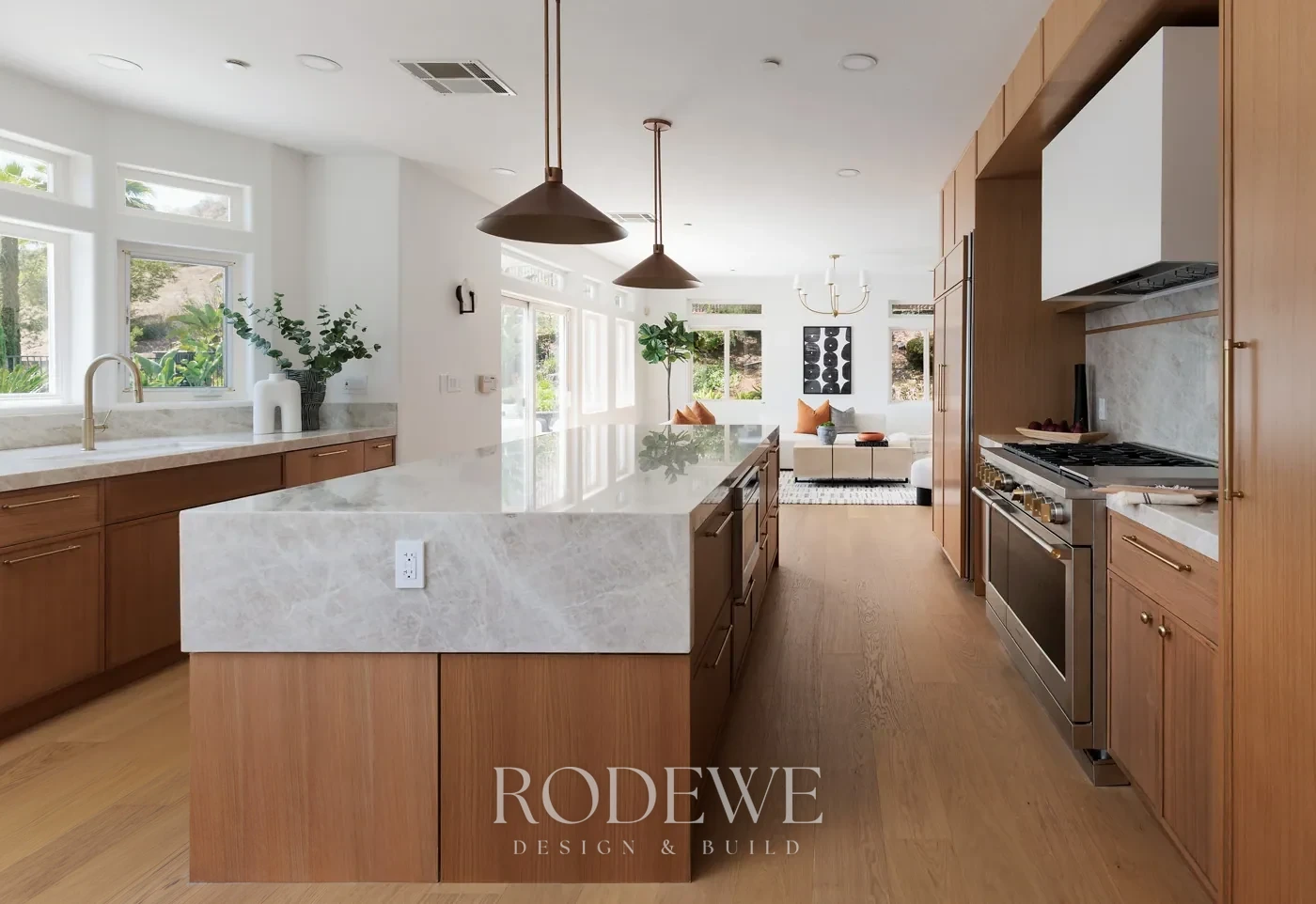
Whole Home Remodeling in San Clemente, CA
Whole home remodeling in San Clemente presents an interesting design challenge.
- CSLB licensedLicense No. 1146843
- Design + buildOne in-house team
- Permits handledPlans, submittals, inspections
- San ClementeReply within one business day
Modernize the Home Without Losing What Makes It San Clemente
Whole home remodeling in San Clemente presents an interesting design challenge.
Many homeowners want brighter spaces, larger openings, better kitchens, more functional floor plans, sophisticated bathrooms, improved indoor and outdoor living, and a cleaner contemporary feeling.
But San Clemente is not a place where the best answer is always to erase the existing architecture and start visually from zero.
The city has character.
Its Spanish influenced architecture, coastal landscape, hillsides, ocean views, courtyards, tile roofs, white plaster walls, mature landscaping, and relaxed connection to the outdoors give San Clemente a residential identity that is noticeably different from many other Southern California communities.
The real opportunity is figuring out what deserves to stay, what needs to change, and how the two can work together.
RODEWE approaches whole home remodeling in San Clemente from both a design and construction perspective. Architecture, interior design, structural changes, materials, permitting, engineering, budgeting, and construction should support one another rather than being treated as separate decisions.
Because the objective is not simply to make an older home look new.
It is to make it feel better without removing everything that made the property interesting in the first place.
A City That Was Designed to Have Character
San Clemente's architectural identity did not happen by accident.
Founder Ole Hanson envisioned the community around a Spanish Colonial Revival character that responded to the rolling coastal terrain and Southern California climate. The City continues to recognize preservation of that architectural heritage as an important part of San Clemente's identity.
That history still influences residential design today.
You see it in white plaster and stucco walls.
Clay tile roofs.
Arched openings.
Courtyards.
Balconies.
Warm wood.
Ironwork.
Deep window openings.
Covered outdoor spaces.
And homes positioned around views, hillsides, and the coastal landscape.
But respecting that heritage does not mean reproducing a historic interior inside every house.
A home can acknowledge San Clemente's architectural character while being completely relevant to the way people live today.
That balance is where thoughtful remodeling becomes much more interesting than simply replacing finishes.
Keep the Character. Remove the Compromises.
Older homes often contain two very different things at the same time.
Character worth keeping and compromises that no longer make sense.
A beautiful exterior may hide an interior divided into too many small rooms.
An original arch may have personality while the kitchen behind it feels disconnected from the rest of the house.
A home may have an incredible ocean view but almost no relationship between that view and the main living spaces.
The primary bedroom may have charm but inadequate storage.
A backyard may be only a few feet from the living room while feeling completely disconnected from it.
Good remodeling begins by separating those two categories.
We ask which elements contribute to the home's identity and which elements simply reflect the limitations of another era.
The result does not need to choose between old and new.
It can use both intelligently.
Spanish Architecture Can Evolve
One of the easiest ways to weaken the character of a Spanish influenced home is to modernize it without understanding the architecture.
The opposite can also happen.
Trying too hard to preserve a traditional appearance can leave a home feeling heavy or overly themed.
There is a middle ground.
A traditional exterior can transition into a cleaner interior.
Original arches can remain while cabinetry becomes simplified.
Warm plaster can replace heavily textured walls.
Terracotta can be used selectively rather than everywhere.
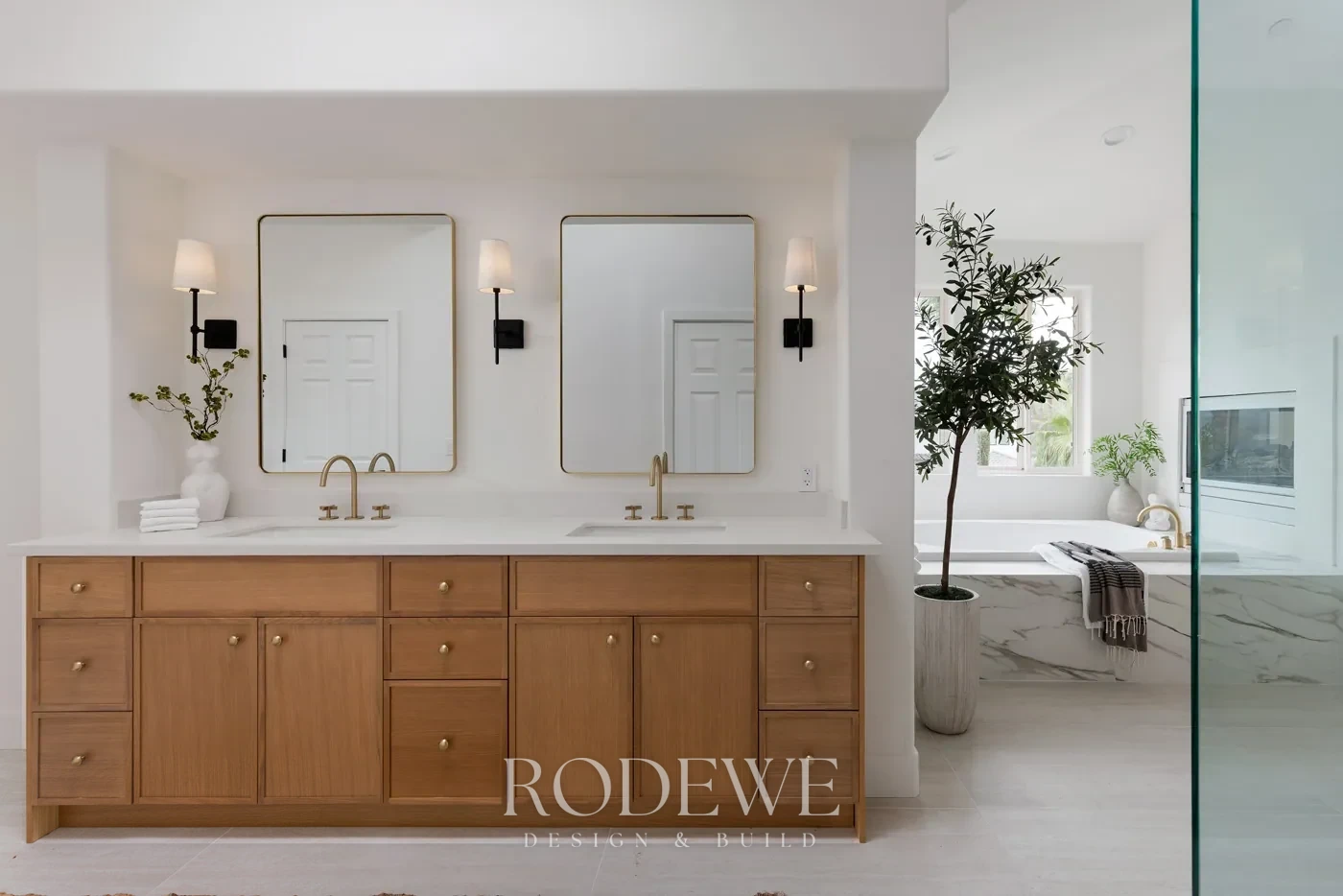
Natural oak can introduce contemporary warmth while still feeling appropriate beside stone, plaster, and handmade tile.
Iron details can become more refined.
Traditional rooms can be opened strategically without eliminating every sense of separation or architectural rhythm.
The goal is not to make a new interior pretend to be historic.
It is to allow the architecture to evolve.
Luxury Here Should Feel Comfortable
San Clemente is coastal, but its identity is not based on formality.
That matters when designing a high end home.
A sophisticated interior should still feel comfortable when the doors are open to the patio.
Materials should look beautiful without making the homeowner afraid to use them.
The kitchen should work just as well on an ordinary morning as it does when twenty people are visiting.
Furniture arrangements should support conversation, family life, views, and entertaining rather than simply photograph well.
Natural materials often work particularly well in this environment because they become more interesting with texture and variation.
Oak.
Limestone.
Travertine.
Marble.
Plaster.
Handmade tile.
Warm metals.
Textured fabrics.
Stone.
The exact combination changes from house to house.
What matters is that the finished home feels refined without losing the relaxed quality that makes coastal living attractive in the first place.
Coastal Design Without the Coastal Clichés
A San Clemente home does not need blue accessories and decorative references to the beach to feel connected to the coast.
The connection can be architectural instead.
Natural light.
Openings toward the outdoors.
Warm white plaster.
Light stone.
Wood.
Textured surfaces.
Views.
Air movement.
Outdoor rooms.
Simple materials used with restraint.
These elements can create a coastal atmosphere without turning the house into a theme.
That approach also tends to age better.
Trends change quickly.
Architecture, proportion, natural materials, and good light tend to last much longer.
The Ocean View Should Influence More Than the Windows
For homes with ocean views, it is easy to assume the solution is simply to install more glass.
Sometimes that is appropriate.
Sometimes it is not.
A view becomes more powerful when the architecture is organized around it.
Where does your eye naturally travel when you enter the house?
What does someone see while sitting at the kitchen island?
Should the dining table face the ocean?
Is a fireplace competing with the best view in the room?
Could a hallway terminate at a window rather than a blank wall?
Would moving one interior wall completely change what is visible from the main living area?
Could the primary bedroom wake up to the view instead of turning away from it?
These questions can influence the floor plan long before windows are selected.
A successful ocean view renovation is not measured by the square footage of glass.
It is measured by how naturally the view becomes part of everyday life.
Let the Inside and Outside Finish Each Other
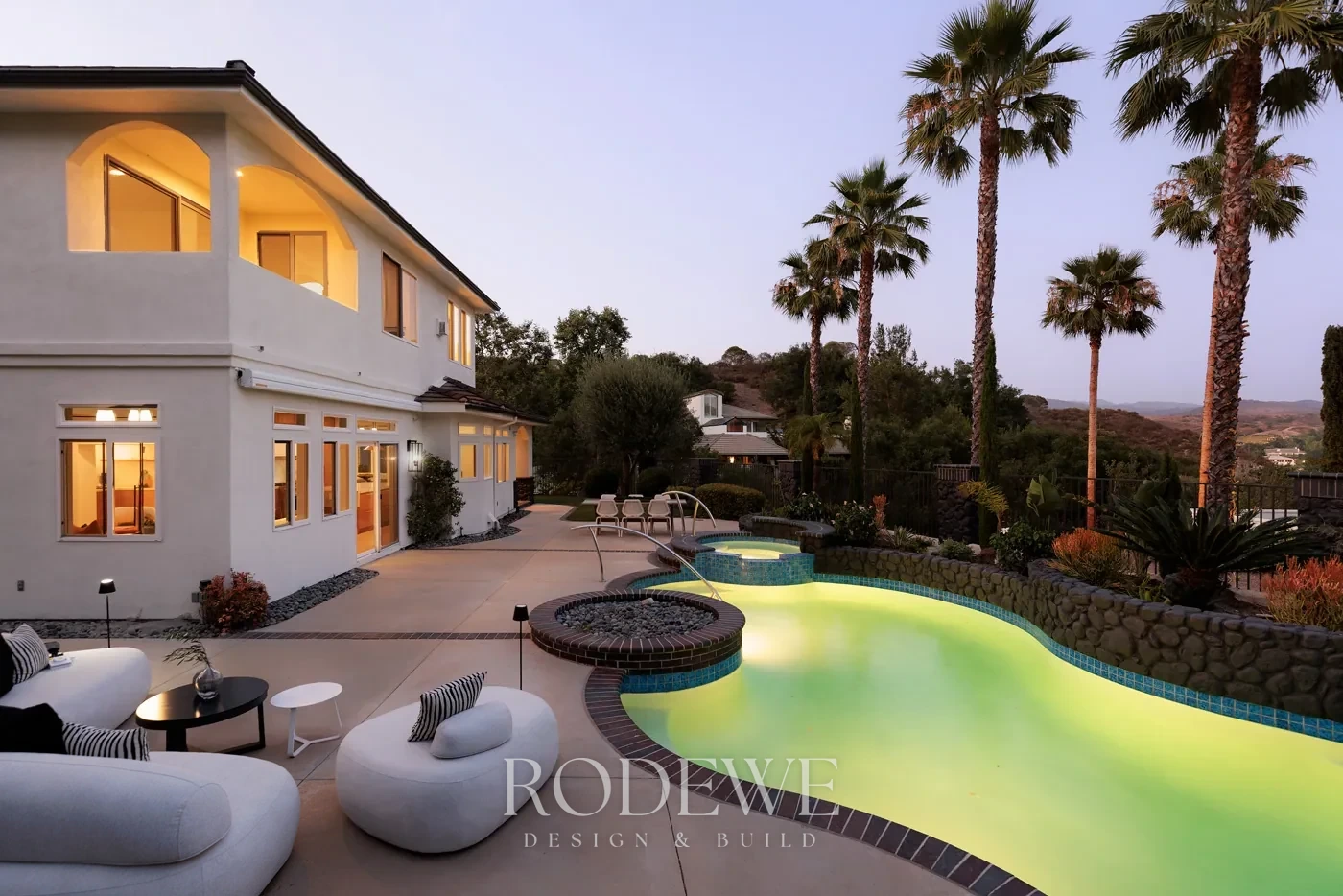
San Clemente's climate makes outdoor living more than an amenity.
It can become part of the floor plan.
That does not necessarily mean installing the largest sliding door available.
The relationship between indoors and outdoors has to work as a complete construction detail.
Floor elevations matter.
Drainage matters.
Thresholds matter.
Waterproofing matters.
Sun exposure matters.
Wind matters.
Privacy matters.
Furniture placement matters.
Shade matters.
Lighting matters.
A beautifully designed opening becomes much less impressive if water management was treated as an afterthought.
The strongest indoor and outdoor spaces feel visually effortless because the difficult construction details have already been resolved.
The Kitchen Should Make the House Better
A luxury kitchen can still be the wrong kitchen.
Expensive appliances, custom cabinetry, and beautiful stone do not automatically solve a poor layout.
During a whole home remodel, the kitchen should be considered in relationship to everything around it.
The dining area.
Living room.
Outdoor spaces.
Views.
Circulation.
Storage.
Pantry.
Appliances.
Lighting.
And the way people gather.
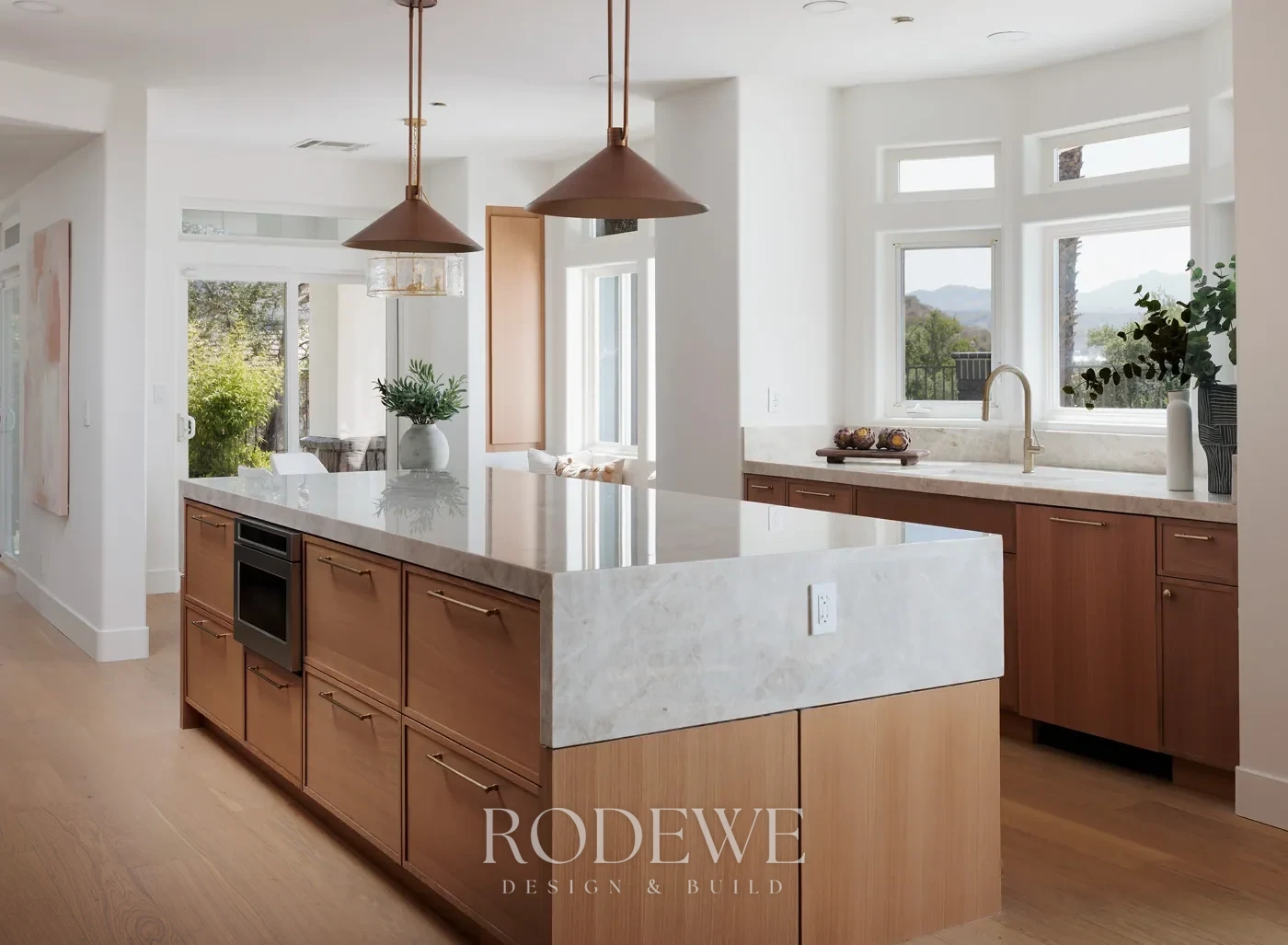
For a Spanish influenced home, the kitchen might use warm oak, natural stone, plaster, subtle arches, handmade materials, or architectural details that reference the home without becoming overly traditional.
For a contemporary coastal home, the same space might become quieter, with simplified cabinetry, integrated appliances, larger stone surfaces, concealed storage, and carefully positioned lighting.
Different appearance.
Same principle.
The kitchen should improve the architecture rather than compete with it.
Bathrooms Can Be Quiet and Still Feel Luxurious
High end bathrooms often become too complicated because every surface is expected to make a statement.
We prefer a more disciplined approach.
A limited material palette can make workmanship and proportion more visible.
One beautiful stone.
Warm cabinetry.
Well placed lighting.
Clean shower glass.
Refined plumbing fixtures.
Thoughtful storage.
Carefully aligned tile or slab surfaces.
The luxury comes from execution.
Where the vanity meets the wall.
How the mirror relates to the lighting.
Where grout joints terminate.
How stone edges are fabricated.
Where outlets disappear.
How the shower glass aligns with architectural lines.
Those details rarely appear on an inspiration board.
They become obvious when the room is finished.
Coastal Materials Need to Age Well
Material selection near the ocean is not purely a design decision.
Salt air, sunlight, moisture, wind, and exposure can influence how exterior metals, hardware, windows, doors, railings, finishes, fixtures, and building components perform over time.
That does not mean every San Clemente property experiences identical conditions.
A protected inland neighborhood and a home directly exposed to ocean air can behave very differently.
Product specifications should respond to the actual property.
RODEWE evaluates materials based on more than appearance.
Durability, maintenance, finish quality, manufacturer requirements, fabrication, installation, and exposure all matter.
Because a material that looks beautiful on installation day but deteriorates prematurely was not the right luxury selection.
Hillside Remodeling Starts Before the Interior Design
Some of San Clemente's most interesting homes occupy sloped sites.
They can also be among the projects where early planning matters most.
The visible remodel may involve kitchens, bathrooms, windows, flooring, or interior layout changes.
Behind those improvements can be another set of conditions involving foundations, retaining walls, drainage, grading, structural engineering, access, staging, and material delivery.
San Clemente's Engineering Division separately administers land development matters that can include grading and retaining conditions, which is one reason substantial site work should be investigated early.
The point is not that every hillside remodel becomes an engineering project.
It is that the site should be understood before the design becomes expensive to change.
A rendering can ignore construction access.
A jobsite cannot.
Your Address Can Change the Rules
One of the most important things to understand about remodeling in San Clemente is that there is no single rulebook that applies identically to every property.
The City has seven Specific Plan areas: Forster Ranch, Marblehead Coastal, Marblehead Inland, Pier Bowl, Rancho San Clemente, Talega, and West Pico Corridor. Those plans can establish additional development standards and design requirements for properties within their boundaries.
The City also maintains an Architectural Overlay District that includes areas such as the Pier Bowl, portions of El Camino Real west of Interstate 5, Downtown Core, and North Beach. Projects within the overlay can be subject to additional architectural review intended to preserve San Clemente's historical and architectural traditions.
That means two homes with similar architecture may still follow different approval paths.
For RODEWE, this is why property research belongs near the beginning of preconstruction rather than near the end of design.
Before major changes are developed, the team should understand where the property sits within the City's regulatory framework.
Historic Does Not Mean Untouchable
San Clemente actively maintains a historic preservation program for buildings, sites, and districts with architectural, historical, cultural, or archaeological significance.
For homeowners, the important question is not simply whether a house looks old.
It is whether the property is designated, historically significant, located near a historic resource, or affected by review requirements.
The City's planning guidance identifies projects on historically significant properties and certain properties near historically significant sites among projects that can require discretionary approval and design review.
That can influence how a remodel is approached.
A historically meaningful feature does not necessarily prevent modernization.
It can become part of the design strategy.
An original façade might remain while the interior changes dramatically.
A distinctive exterior element might inspire new interior details.
A property can gain modern functionality without pretending its history never existed.
Coastal Properties Need Their Approval Path Understood Early
Coastal development adds another layer of property specific planning.
San Clemente has an adopted Coastal Land Use Plan, and coastal development requirements can differ depending on property location and scope. Certain projects can involve both local review and California Coastal Commission procedures.
The correct response is not to assume that every coastal remodel is difficult.
It is also not to assume that an interior renovation and a significant exterior alteration will follow the same process.
The approval path should be investigated before major architectural decisions are locked in.
That may involve reviewing planning history, zoning, prior Coastal Commission records, overlays, and existing approvals. San Clemente itself notes that property planning history can provide information about Coastal Commission records, zoning, historic status, and development history.
When those questions are answered early, the design can respond to reality rather than discovering it later.
Good Preconstruction Is Mostly About Asking Questions Early
Many expensive construction problems begin as small unanswered questions.
Has the appliance package been finalized before cabinetry is engineered?
Does the selected door system work with the waterproofing condition?
Has the stone thickness been coordinated with cabinetry?
Does the lighting plan know where the ceiling framing will be?
Can the selected material actually be delivered to the site?
Does the structural design leave room for mechanical systems?
Are exterior elevations consistent with planning approvals?
Has the homeowner selected something with a six month lead time without realizing it?
None of these problems are glamorous.
Solving them early is.
RODEWE uses preconstruction to connect architectural intent with the practical requirements of building the project.
Architects, engineers, designers, subcontractors, fabricators, suppliers, and specialty consultants should not discover one another's decisions for the first time after construction begins.
The Finish Standard Is Set Long Before Finish Work Begins
High end construction is often judged by the final ten percent of the project.
But the quality of that final ten percent depends on decisions made much earlier.
Wall framing affects cabinetry.
Cabinetry affects stone.
Stone affects plumbing fixtures.
Lighting affects millwork.
Flooring affects door heights and transitions.
Window dimensions affect interior and exterior detailing.
Waterproofing affects door systems.
These relationships are why luxury remodeling requires coordination, not simply premium products.
RODEWE has relationships with quality suppliers, manufacturers, fabricators, showrooms, and specialty vendors throughout Southern California.
Those relationships can provide access to premium materials and professional pricing when available.
But access is only useful if the correct product is selected for the design.
We care as much about how a material will be detailed and installed as we do about the name on the box.
A Renovation Should Feel Like It Happened Once
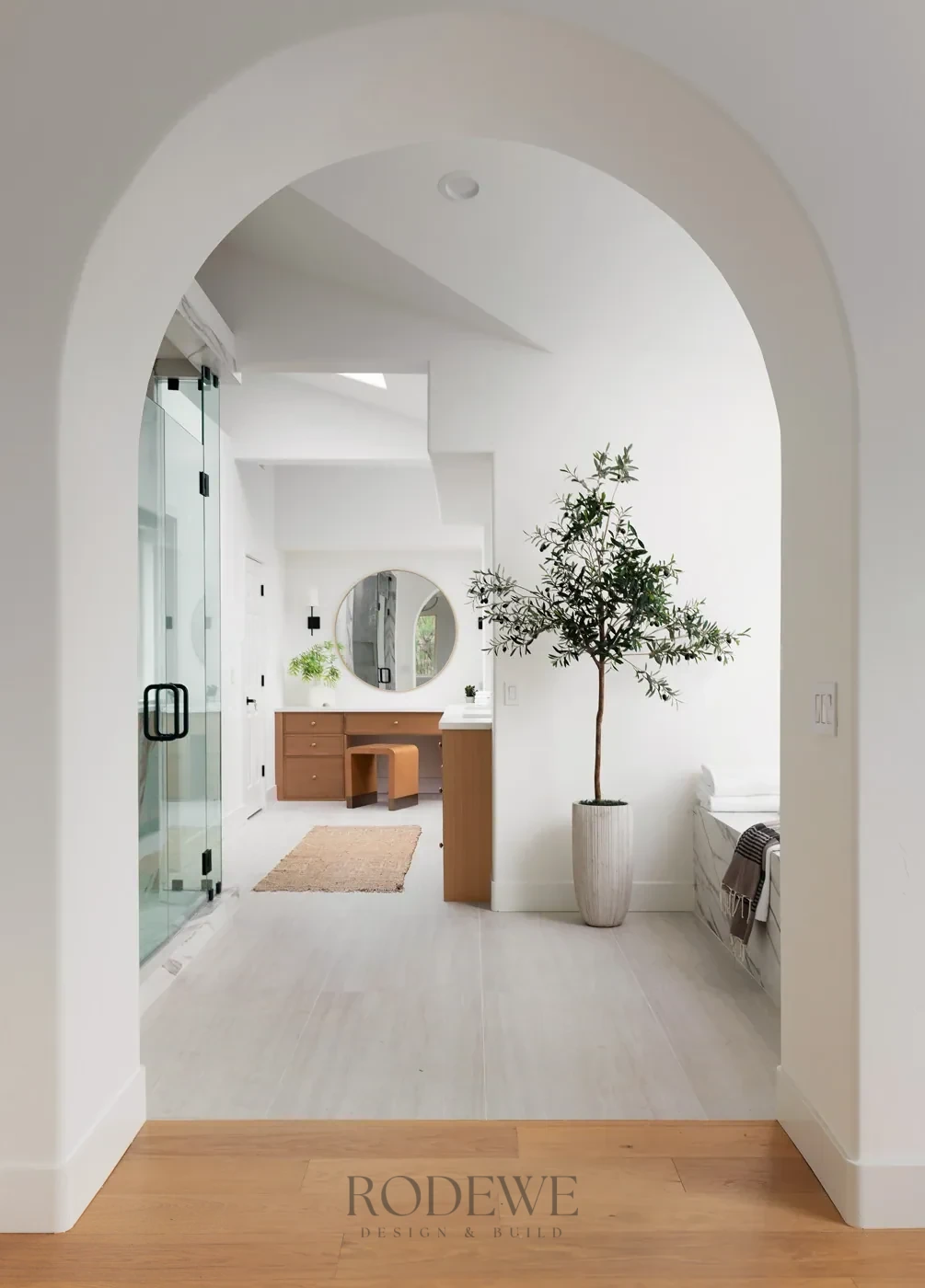
Many homes reveal their remodeling history immediately.
One flooring material belongs to one decade.
The kitchen belongs to another.
The bathrooms belong to a third.
Hardware changes from room to room.
Door heights vary.
Lighting color changes.
Cabinetry styles have no relationship to each other.
Nothing is necessarily wrong individually.
The house simply does not feel resolved.
A whole home remodel creates an opportunity to correct that.
Not by making every room identical, but by establishing relationships.
A wood species might appear prominently in the kitchen and quietly return in a bathroom vanity.
A stone used in one major room might reappear as a smaller detail somewhere else.
Hardware can follow a consistent logic.
Door proportions can relate.
Lighting can share the same temperature and architectural approach.
The rooms can have individual personalities while still feeling as though they belong to the same house.
That is cohesion.
Remodel Around Your Priorities, Not Someone Else's Checklist
A successful home is not designed by counting features.
It starts with priorities.
Some homeowners care most about entertaining.
Some want quiet.
Some need better storage.
Some want a home that opens almost completely to the outdoors.
Some care deeply about cooking.
Some want space for children and guests.
Some want art to become central to the architecture.
Others want the view to do almost all the talking.
Those priorities affect where money should be spent.
A homeowner who cooks every day may benefit more from cabinetry, appliances, workflow, and lighting than from an elaborate formal room that is rarely used.
Someone who spends every evening outdoors may value door systems, patios, landscaping, lighting, and exterior amenities differently.
The best renovation budget is not distributed equally.
It is distributed intentionally.
Our Whole Home Remodeling Process in San Clemente
Start With the Property
We begin with the existing home, its condition, site, architectural character, homeowner priorities, budget, and intended scope.
Understand the Rules Before Designing Around Them
Zoning, planning history, Specific Plan requirements, architectural overlays, coastal conditions, historic considerations, HOA requirements, structural conditions, and site constraints are investigated where relevant.
Develop the Architecture and Interior Together
Floor plans, elevations, cabinetry, lighting, windows, doors, stone, flooring, fixtures, appliances, and major material decisions are coordinated as parts of the same home.
Bring Technical Expertise Into the Design
Structural engineers, architects, specialty consultants, fabricators, subcontractors, and suppliers are involved when their input can resolve a decision before it becomes a construction problem.
Build the Budget Around the Actual Project
We prefer project specific budgeting over generic promises based solely on square footage.
Scope, specifications, existing conditions, engineering, materials, cabinetry, windows, doors, appliances, and construction complexity all influence the real number.
Prepare Before Demolition
Permitting, procurement, long lead materials, site logistics, construction sequencing, trade coordination, and major selections should be developed as far as reasonably possible before the house is opened up.
Build With the Final Detail in Mind
Construction moves from demolition and rough work through structural work, building systems, waterproofing, windows, doors, cabinetry, stone, flooring, lighting, fixtures, finishes, and final adjustments.
Each phase affects the one that follows.
Frequently asked questions
How much does a whole home remodel in San Clemente cost?
There is no single cost that accurately represents every San Clemente renovation.
The existing home, square footage, structural changes, hillside conditions, cabinetry, windows and doors, appliances, finish level, mechanical systems, exterior work, site access, and engineering can all significantly affect the budget.
For substantial renovations, the scope and specifications provide much more useful information than a generic cost per square foot.
How long does a whole home renovation take?
The overall timeline can include design, architecture, engineering, HOA review where applicable, City review, coastal approvals where required, procurement, fabrication, and construction.
A cosmetic project and a major structural renovation should not be given the same schedule.
The most useful timeline is one developed around the actual property and scope.
Do I need permits for remodeling in San Clemente?
Many significant remodeling projects require permits, particularly when structural, electrical, plumbing, mechanical, window, deck, retaining wall, or similar work is involved. The required permits depend on the project. San Clemente provides separate building and planning processes for residential work.
Does every San Clemente remodel require design review?
No.
Design review depends on the location and nature of the project.
The City identifies several categories that commonly involve discretionary review, including projects in the Architectural Overlay District and projects involving certain historically significant sites or neighboring properties.
Can a Spanish style home be modernized without losing its character?
Yes.
That is one of the most interesting opportunities in San Clemente remodeling.
Architectural character can be preserved through massing, exterior materials, roof forms, arches, courtyards, plaster, wood, tile, and other meaningful elements while interiors become significantly more contemporary.
The goal does not have to be preservation or modernization.
It can be both.
Do coastal homes require different materials?
Sometimes.
The appropriate specification depends on the property's actual exposure.
Homes subject to greater salt air, moisture, wind, and sunlight may benefit from more careful selection of windows, doors, exterior hardware, railings, metals, finishes, waterproofing assemblies, and related components.
The best material is the one appropriate for both the architecture and the environment.
What should homeowners consider when remodeling a hillside property?
Structural conditions, drainage, grading, retaining walls, foundations, construction access, staging, neighboring properties, equipment access, and material delivery can all influence the project.
These conditions should be investigated early when they are relevant rather than after the design is substantially complete.
Can RODEWE coordinate interior design and construction?
Yes.
RODEWE approaches remodeling with both design and construction in mind.
Depending on the scope, the project may also require architects, engineers, specialty consultants, subcontractors, fabricators, and suppliers.
The objective is to coordinate those disciplines around one project rather than allowing critical decisions to develop independently.
Should I remodel my San Clemente home or build new?
The answer depends on what you already have and what you are trying to create.
If the existing structure, architecture, foundation, or allowable development has meaningful value, a major remodel may make sense.
If achieving the desired home would require removing or restructuring most of what exists, comparing renovation with custom home construction may be worthwhile.
The decision should consider architecture, zoning, structural conditions, budget, approvals, schedule, and long term plans for the property.
What Should Stay, and What Should Become Something New?
That question sits at the center of whole home remodeling in San Clemente.
Some houses contain architecture worth protecting.
Some contain great architecture hidden behind decades of alterations.
Some have extraordinary sites but interiors that do not take advantage of them.
And some need a much more complete transformation.
The answer should not come from a standard remodeling formula.
It should come from the property.
RODEWE brings together interior design, construction planning, architects and engineers where required, premium materials, experienced trades, budgeting, and project management to develop a renovation around the specific home rather than forcing the home into a predetermined style.
We believe a successful San Clemente renovation should feel current without becoming anonymous.
Sophisticated without becoming formal.
Coastal without becoming themed.
And respectful of the architecture without becoming trapped by it.
The goal is not simply to replace what is old.
It is to recognize what gives the home value, remove what prevents it from working better, and create something that feels naturally connected to both the homeowner and San Clemente.
Considering a whole home remodel in San Clemente? Contact RODEWE to discuss your property, what is worth preserving, and what could be completely reimagined.
More in San Clemente
ADU Construction in San Clemente · Bathroom Remodeling in San Clemente · General Contractor in San Clemente · High End General Contractor in San Clemente · High End Remodeling Contractor in San Clemente · Home Additions in San Clemente · Interior Design in San Clemente · Kitchen Remodeling in San Clemente · Real Estate Investment Renovation in San Clemente
Whole Home Remodeling in nearby cities
Whole Home Remodeling in Costa Mesa · Whole Home Remodeling in Coto de Caza · Whole Home Remodeling in Dana Point · Whole Home Remodeling in Irvine · Whole Home Remodeling in Laguna Beach · Whole Home Remodeling in Laguna Hills · Whole Home Remodeling in Laguna Niguel · Whole Home Remodeling in Newport Beach
Countywide guides
Home Additions in Orange County · ADU Construction in Orange County · General Contractor in Orange County · Bathroom Remodeling in Orange County · Interior Design in Orange County · Kitchen Remodeling in Orange County · Whole Home Remodeling in Orange County · Construction Project Management in Orange County
Featured projects
Lusitano: Coto de Caza · Espalter: Mission Viejo · Sapphire: Balboa Island, Newport Beach
Guides
Design-build vs architect + general contractor · ADU vs JADU in Orange County · All articles
Explore
Our projects · Portfolio · How we work · All local guides · Construction management · Real estate investment · Request a consultation
Planning a project in San Clemente?
Tell us about your home and goals. We will respond within one business day with next steps.
Request a free consultation
Tell us about your project. We reply within one business day.
- Phone: (949) 883-8438